
8 月 13, 2026
Last month, a food plant manager called me in a panic. His workers kept complaining about a sharp, pungent smell near the cold storage room. Some said it smelled like bleach; others said it was more like rotten eggs. 🥶👃
He had already called the HVAC team, checked the drain pipes, and even replaced the door seals – nothing helped.
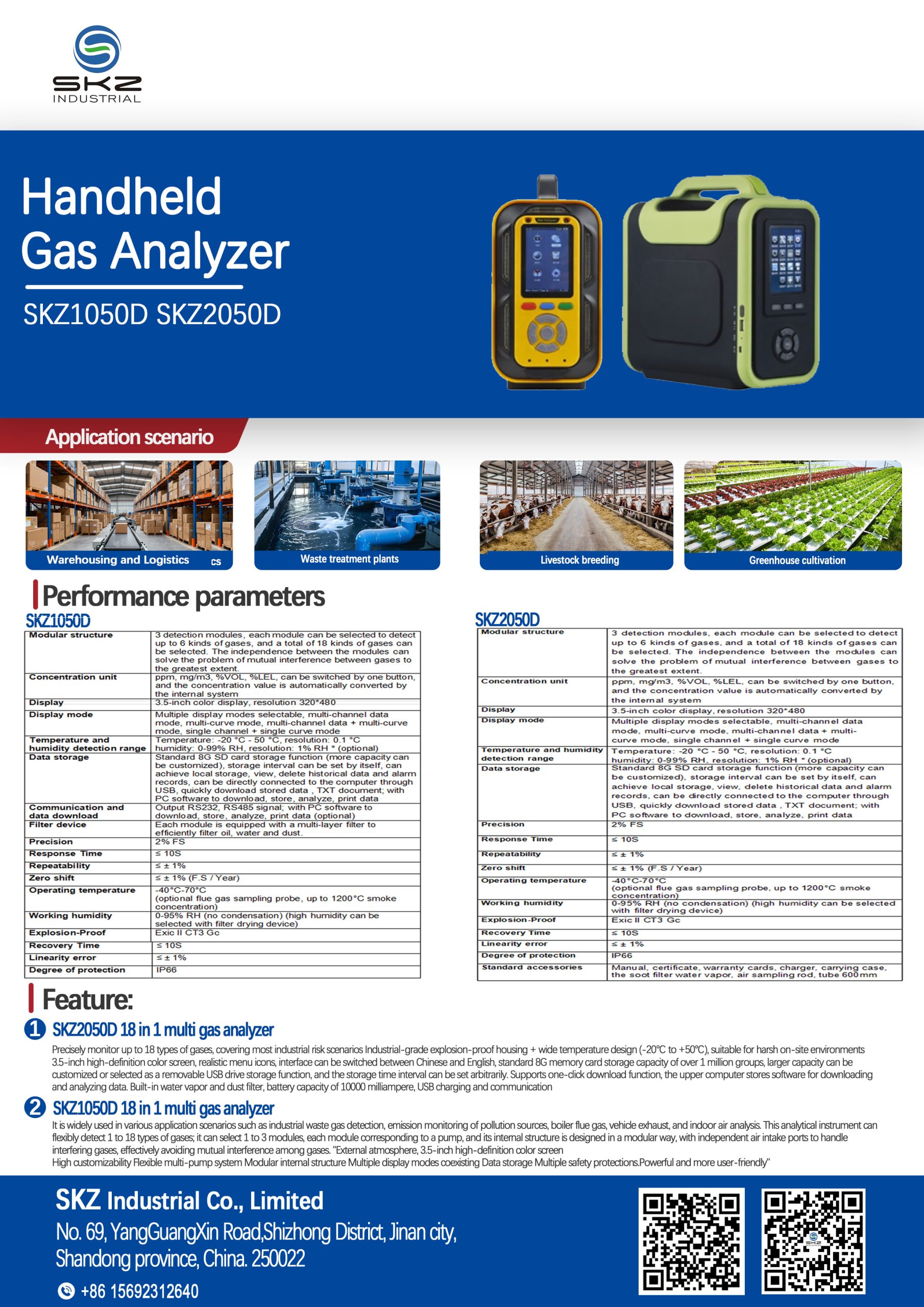
I walked in with my SKZ1050D – a handheld gas analyzer that fits in my backpack. Instead of guessing, I let the device do the detective work.
The first thing I did was attach two separate modules: one for ammonia (NH₃) and one for hydrogen sulfide (H₂S). Each module has its own independent air inlet and pump, so the air sample for ammonia never touches the H₂S sensor. No cross‑interference, no blended readings.
I held the probe near the condenser unit – ammonia spiked immediately. Then I moved to the floor drain – H₂S shot up, while ammonia stayed flat. Two different sources, one device, both caught cleanly.
Turns out, the refrigeration line had a microscopic leak, and some food residue in the drain was decomposing. Both were causing different smells, but they were mixing in the air and confusing everyone.
We fixed the refrigerant line, cleaned the drain, and installed a small exhaust fan. The smell vanished in one day.
Since then, I’ve used the same SKZ1050D for boiler stack checks, car exhaust measurements, and even indoor air quality in a renovated office. It can detect 1 to 18 gases – you just choose 1–3 modules based on what you suspect.
What impressed me most? It doesn’t mix signals. Each gas gets its own clean path – so you get the real story, not a muddled guess. And that real story saves time, money, and headaches.
 Chinese
  English
  Home
Home
 Products
 Email
Email
 WhatsApp