
10 月 06, 2026
I’ll never forget that morning.
I was leading a water quality study across four different watersheds. Six months of planning. Permits from three government agencies. A team of five grad students depending on me. Grant money that took two years to secure.
We set up at our first site before sunrise. The stream was perfect — clear water, good flow, exactly what we needed for baseline data.
I pulled out my portable pH meter. The one I’d used for years. The one I trusted.
It wouldn’t calibrate.
I tried again. And again. The screen kept throwing error codes. The readings jumped between 4.2 and 9.8 on the same sample. My students were watching. The morning light was burning. And I could feel six months of work slipping through my fingers.
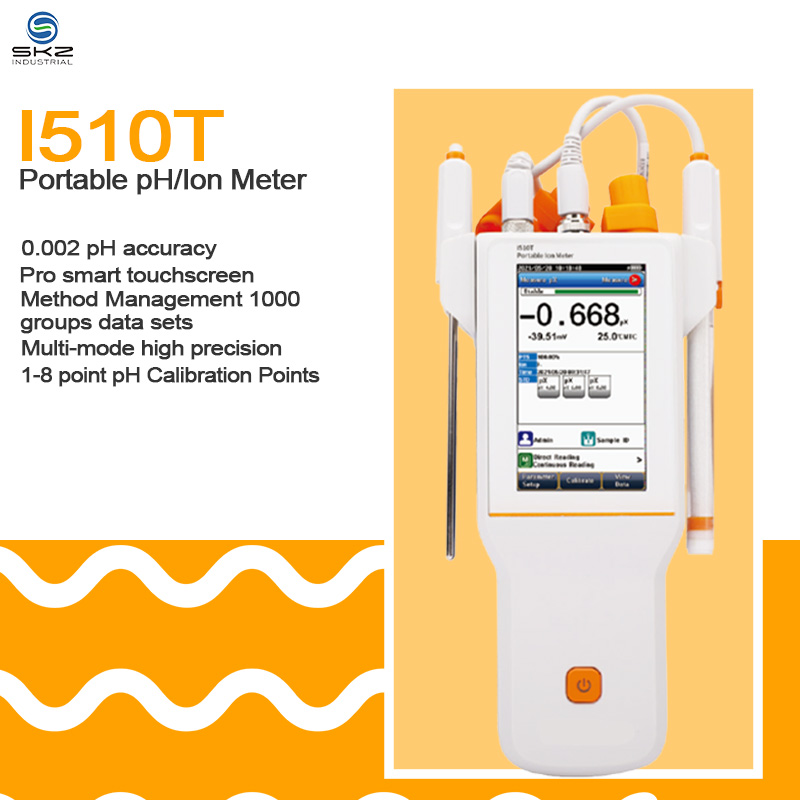
That’s when Sarah, one of my grad students, handed me a meter I’d never seen before. “I brought a backup,” she said. “It’s the SKZ I510T. My advisor recommended it.”
I almost laughed. A portable meter? For serious research? I’d been burned by portable meters before — they’re fine for quick checks, but not for publishable data.
Then I turned it on.
The 4.3-inch touchscreen lit up like a small tablet–. I tapped through the menu — calibration management, electrode management, method management–. The 1-8 point calibration with standard recognition found my buffers instantly–. Two minutes later, I was calibrated and running samples.
The readings came in clean. Stable. Repeatable. ±0.002 pH accuracy– — my lab benchtop meter couldn’t even claim that–.
We ran 43 samples that day across all four sites. The I510T stored every single one — 1000 data sets with full GLP-compliant timestamps–. Temperature compensation kicked in automatically. The IP65 waterproof rating meant I didn’t panic when a student nearly dropped it in the stream–.
By sunset, we had our data. Clean, reliable, publishable.
That night, I looked at my old meter sitting in my bag. The one I’d trusted for years. The one that almost cost me everything.
Sometimes the best tool isn’t the one you’re used to. It’s the one that shows up when you need it most.
 Chinese
  English
  Home
Home
 Products
 Email
Email
 WhatsApp